
The Invisible Supply Chain
How AI is Rebuilding Fashion Logistics from the Inside Out
6/3/20264 min read
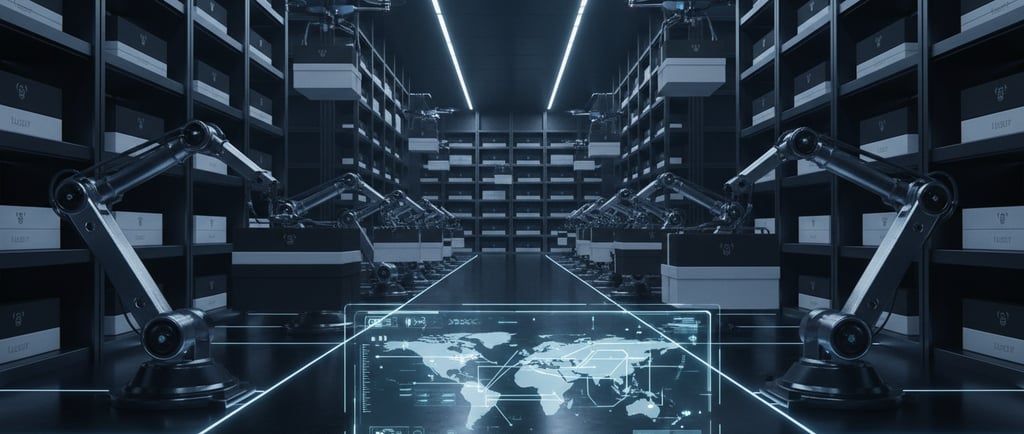
In the fashion industry, the "magic" usually happens on the runway or the glossy pages of a magazine. We talk about the silhouette, the fabric, and the celebrity muse. But the most profound revolution in 2026 isn't happening in the design studio—it’s happening in the shipping container, the warehouse, and the cotton field.
For decades, the fashion supply chain has been built on a "push" model: make as much as possible, as cheaply as possible, and hope people buy it. This resulted in the industry’s greatest failure: overproduction. Every year, billions of dollars worth of unsold garments are burned or buried because demand wasn't predicted correctly.
Now, an Invisible Supply Chain is emerging. Powered by AI and real-time data, this new model is shifting the industry toward a "pull" system—where we only manufacture what the world actually needs. By rebuilding logistics from the inside out, AI is doing the impossible: making fashion more profitable and more sustainable at the same time.
As McKinsey notes, operational excellence is the theme of 2026. Brands that cannot master the "back-end" of their business with AI will be crushed by the inefficiencies of the old model. Vogue Business adds that the maturing of AI tech is finally allowing for "predictive" rather than "reactive" inventory management.
From Guesswork to Predictive Inventory
The traditional fashion calendar is a series of educated guesses made 18 months in advance. Designers guess what will be popular, buyers guess how many to order, and factories guess their capacity. When those guesses are wrong—which they frequently are—the result is either a stockout (lost revenue) or an overstock (landfill).
AI is replacing these guesses with Predictive Demand Engines. By analyzing billions of data points—everything from Google search trends and TikTok "viral potential" to weather patterns and global economic indicators—AI can predict the demand for a specific SKU with terrifying accuracy.
Micro-Seasons: Instead of two major seasons, brands are using AI to launch smaller, more frequent "micro-collections" that respond to real-time cultural shifts.
Dynamic Stock Allocations: AI knows that a heatwave in Milan means a brand should pivot its warehouse focus from coats to linens three weeks before a human would notice.
This isn't just "fast fashion" moving faster; it’s a more intelligent use of resources that reduces the industry's carbon footprint by ensuring zero unnecessary production.
The "Glass" Supply Chain: End-to-End Transparency
One of the biggest hurdles in fashion has been the "black box" of the tier-2 and tier-3 suppliers. Most brands don't actually know where their buttons, zippers, or raw cotton come from. In an era of increasing regulation—like the EU’s Digital Product Passport (DPP)—this lack of visibility is a major legal risk.
AI is creating a Transparent Supply Chain by:
Blockchain Integration: Tracking the journey of a single fiber from a farm to a finished garment.
Automated Sourcing: AI agents can now "scout" for suppliers that meet specific sustainability and ethical criteria faster and more accurately than human sourcing teams.
Real-Time Risk Mitigation: If a hurricane is brewing near a primary textile hub, the AI has already rerouted the supply chain and notified alternative factories before the storm even hits landfall. McKinsey — The State of Fashion 2026
The Smart Warehouse: Where Humans and Robots Co-exist
Step into a 2026 distribution center, and you won't see rows of workers manually picking garments. You’ll see a symphony of Autonomous Mobile Robots (AMRs) and AI-driven sorting systems.
These "Smart Warehouses" are optimized by AI to:
Minimize Pathing: Robots compute the absolute most efficient path to pick an order, reducing energy consumption and fulfillment time.
Predictive Packaging: AI identifies the smallest possible box for every order, saving millions in shipping costs and reducing cardboard waste.
Returns as Inventory: In the old model, a returned item could take weeks to be resold. AI-driven sorting allows a return to be inspected, re-bagged, and placed back into the "active" inventory pool in minutes.
Localized Micro-Factories and "On-Demand" Production
Perhaps the most radical change in the invisible supply chain is the move away from massive, overseas factories toward localized micro-factories.
If a brand has a high-fidelity "Digital Twin" of a garment (as we discussed in a previous post), they don't need to make 10,000 units in Bangladesh and ship them on a slow boat. Instead, they can send the digital pattern to an automated micro-factory in the same country as the consumer.
The garment is printed, cut, and sewn only after the customer hits "buy." This "Pull" model:
Eliminates the need for massive warehouses.
Removes the carbon cost of long-distance freight.
Allows for the hyper-personalization we see in modern luxury.
Closing the Loop: AI and Circularity
The supply chain doesn't end when the customer receives the box. AI is now powering the Circular Economy by:
Automated Sorting for Recycling: AI vision systems that can identify fiber blends (like poly-cotton vs pure wool) to ensure garments are recycled into the correct streams.
Resale Algorithms: AI helps brands launched their own "pre-loved" platforms by automatically authenticating items and setting "fair market value" based on real-time data.
As Forbes notes, the ability to close the loop on products is becoming the ultimate differentiator for luxury brands looking to sustain their high-end reputation in an eco-conscious market.
The Bottom Line
We are witnessing the death of the "Push" supply chain. Logistics is no longer a boring back-end function; it is the core of a brand's survival strategy.
The invisible supply chain doesn't need to be seen by the consumer to be felt. They feel it in the faster shipping, the more accurate "in-stock" alerts, and the lower environmental guilt. For the brand, AI in logistics is the difference between a profitable, agile future and a warehouse full of "ghost" inventory from a past that no longer exists.
Luxury
Elevate your brand with our exclusive AI models.
Contact us
THE SYNTHETIC FRONTIER
© 2026. All rights reserved.
(609) 901-8073