The Fashion Operating Systems
Why Every Major Brand Is Building Its Own AI Brain
6/24/20263 min read
For decades, fashion companies were a collection of silos. The design team lived in one world, the supply chain team in another, and marketing lived in a third. Information moved slowly—often through spreadsheets, physical samples, and "gut feelings." This fragmentation was the industry’s greatest weakness, leading to overproduction, missed trends, and disconnected customer experiences.
But in 2026, the silos are being demolished. We are entering the era of the Fashion Operating System (Fashion OS).
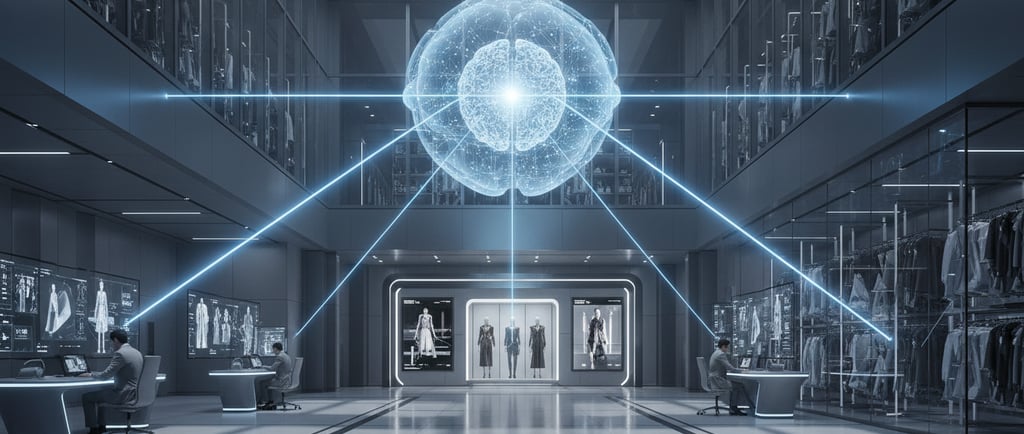
In this new model, every department of a brand is connected to a single, proprietary AI Brain. This isn't just a suite of tools; it is a unified intelligence layer—an operating system—that manages the entire lifecycle of a garment, from the first digital sketch to its fifth resale. By consolidating their data into a central AI, brands are achieving a level of speed and precision that was previously impossible.
As McKinsey describes it, "Operational Excellence" in 2026 is no longer about human management; it’s about Systemic Integration. Vogue Business adds that the brands that survive are the ones that view AI as their "central nervous system" rather than just a peripheral gadget.
The "Full-Stack" Intelligence: How the Fashion OS Works
A Fashion OS connects four critical pillars that were previously separate:
Generative Design & Merchandising: Instead of separate teams, the design AI is fed real-time data from the sales AI. If a specific neckline is trending on social agents, the "Brain" instantly updates the 3D design queue, suggesting modifications that align with the brand’s aesthetic DNA.
Autonomous Supply Chain: The moment a design is greenlit by a human editor, the OS checks factory capacity, raw material levels, and carbon budgets. It doesn't ask for permission; it automatically routes the order to the most efficient micro-factory.
The Agentic Customer Layer: The brand's AI Luxury Concierge (as discussed in a previous post) is not a standalone bot—it is a direct interface for the Fashion OS. It knows exactly what is being made in the factory and can "pre-sell" items to consumers whose Digital Twins have already "vibe-checked" the designs.
The Circular Ledger: The OS tracks every item's unique digital ID. When a customer wants to resell a garment, the OS already has the authenticity papers, the original price, the material composition, and the optimal resale value ready.
Why "Proprietary" AI is the New IP
In 2024, everyone used the same public LLMs. In 2026, the elite brands have moved to Proprietary AI Models.
A brand like Noir Starr doesn't want its AI to think like ChatGPT; it wants its AI to think like the brand. They train their "Brain" on their private archives, their unique fit standards, and their specific demographic’s cultural signals.
Brand Consistency: The AI ensures that every piece of marketing content, every stitch, and every customer interaction reflects a perfectly consistent brand voice.
Competitive Advantage: You can copy a garment’s design, but you can’t copy the data-driven intelligence that told the brand exactly when to release it and to whom.
The "Control Room" Culture: The End of the Spreadsheet
Walk into the "Design Studio" of a major brand today, and it looks more like a NASA control room. Designers and executives sit in front of unified dashboards that visualize the entire brand ecosystem in real-time.
They see Sentiment Loops: The OS flags that a specific influencer's post in Tokyo is causing a 15% spike in searches for "asymmetrical knitwear."
They see Inventory Flow: The OS shows that a warehouse in Berlin is overstocked on linens and automatically creates a targeted marketing campaign for that region to clear the stock without a broad discount.
As Forbes notes, the Fashion OS has turned management from a "reactive" game to a "predictive" science.
The Challenges: Data Sovereignty and Talent
Building a Fashion OS is not easy. It requires a radical shift in hiring. Brands are now competing with Silicon Valley for AI architects and data ethicists. There is also the significant challenge of Data Sovereignty—ensuring that their proprietary "Brain" doesn't leak its secrets back into the public LLMs.
Legislative eyes are also watching. Shermin Lakha of Lvlup Legal suggests that the next wave of fashion litigation won't be about trademarked logos, but about "algorithm bias" and the ownership of the data that trains these brand-specific OS systems.
The Bottom Line: The Integrated Future
The brands of the past were collections of people; the brands of the future are integrated systems. A Fashion OS allows a brand to be small enough to be personal and large enough to be global. It is the end of the "disorganized" fashion industry.
In 2026, the most valuable part of a fashion house isn't the name in silk on the label—it's the code that makes sure that label is in the right place, at the right time, for the right person. The operating system is the brand.
Luxury
Elevate your brand with our exclusive AI models.
Contact us
THE SYNTHETIC FRONTIER
© 2026. All rights reserved.
(609) 901-8073