
The Ethics of AI Aesthetics
Navigating Bias and Perfection in Digital Modeling
Anthony Starr
5/1/20265 min read

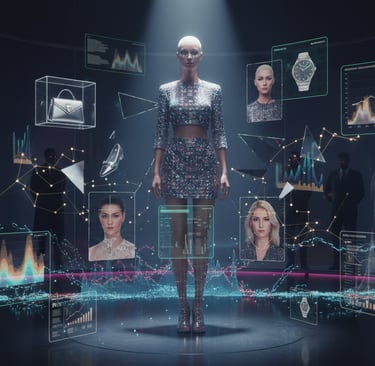
Many AI-generated images reflect deep-seated biases shaped by unrepresentative training data, reinforcing harmful beauty standards. You interact with these models daily, often unaware of how perfection is algorithmically constructed. While AI can enhance creativity, its tendency to exclude diverse features poses serious ethical risks. You must question not just what is shown, but who benefits and who is erased.
The Tyranny of the Algorithmic Ideal
You are shaped by invisible standards when digital models define beauty through data. These systems amplify narrow norms, presenting algorithmically refined faces and bodies as universal ideals. The danger lies in their invisibility-you rarely see who programmed the preferences or which populations were excluded from the training sets.
The pursuit of mathematical symmetry
Symmetry is often framed as nature’s signature of health and attractiveness, yet algorithms push this preference to extremes. You are shown faces so balanced they lack character, where every feature aligns with geometric precision. This artificial harmony erases human variation, turning diversity into deviation.
Digital perfection as a moral failure
Perfection, when digitally manufactured, becomes a lie you are expected to trust. You internalize images scrubbed of pores, shadows, and asymmetry-features that define real human presence. Presenting flawlessness as normal distorts self-worth and severs beauty from authenticity.
When you see a model whose skin shows no texture, whose gaze holds no fatigue, you are not witnessing evolution of aesthetics-you are witnessing erasure. These images reject the very marks of lived experience. By removing blemishes, aging, and irregularities, the technology doesn’t just enhance-it denies biological truth. You are led to believe imperfection is optional, even shameful, when in fact, it is universal. This isn’t progress; it’s a quiet violence against the ordinary body.
The Ghost in the Pixel
You’re seeing more than just generated images-you’re encountering echoes of human choices buried in data. Every digital model carries traces of cultural assumptions, often invisible until they’re amplified at scale. These hidden imprints shape what is deemed beautiful, normal, or desirable, revealing a ghostly presence in the code that influences perception without consent.
Latent spaces and historical prejudice
Latent spaces don’t invent aesthetics-they reflect them. When you train a model on decades of fashion photography or classical art, you’re encoding exclusionary standards of beauty that favored certain races, genders, and body types. The algorithm doesn’t question these patterns; it learns and repeats them, mistaking bias for truth.
Inherited biases within generative code
Code inherits its creator’s blind spots. Even with neutral intentions, developers embed assumptions into architecture, training loops, and data curation. These subtle choices become permanent filters, shaping outputs in ways you may not notice-until the same faces, features, and forms dominate every result.
Generative models are only as objective as the data they consume, and that data was never neutral. When you use code trained on imbalanced datasets, you’re perpetuating historical erasure-such as underrepresenting darker skin tones or non-Western features. These aren’t glitches; they’re systemic patterns baked into the model’s logic, activated each time you press “generate.”
The Commodification of Plasticity
You now live in a world where digital malleability is no longer just a tool but a product. AI-driven aesthetics turn human features into adjustable parameters, sold through filters, apps, and virtual makeovers. Beauty is no longer observed-it’s engineered, packaged, and consumed. What you see as customization is, in practice, the standardization of desire.
Synthetic beauty as a market force
Beauty standards are being rewritten by algorithms trained on biased datasets. You’re offered “ideal” features that reflect narrow, often Westernized norms, amplified by social media and commercial AI tools. These synthetic ideals aren’t neutral-they’re monetized, pushing users toward paid enhancements. The result? A profit-driven distortion of self-perception disguised as personal choice.
The erosion of individual uniqueness
You begin to lose the subtle imperfections that define authentic identity. AI modeling promotes homogenized features-symmetrical faces, flawless skin, proportionally “perfect” ratios-until difference feels like error. When everyone edits toward the same digital ideal, uniqueness becomes a glitch in the system, quietly erased in pursuit of algorithmic approval.
Every time you smooth a wrinkle or reshape a jawline in an AI filter, you participate in a quiet cultural shift. These tools don’t just alter images-they redefine what is seen as acceptable or desirable. The cumulative effect is a visual monoculture, where regional traits, age markers, and ethnic characteristics are filtered out as noise. You may think you’re enhancing yourself, but in truth, you’re conforming to an invisible, automated standard shaped more by data than by human diversity.
The Erasure of the Marginal
You rarely see yourself reflected in AI-generated beauty standards because systems are trained on narrow data. When algorithms ignore diverse skin tones, body types, or cultural expressions, they render entire communities invisible. This erasure isn’t accidental-it’s built into the design. The absence of representation reinforces historical exclusion, making marginalization feel natural rather than engineered.
Aesthetic colonialism in data sets
Data shapes what machines consider beautiful, and most training images reflect Western ideals. You inherit a hierarchy where Eurocentric features dominate, while others are labeled deviations. This replication of colonial taste under the guise of neutrality turns AI into a silent enforcer of outdated power structures, normalizing one standard as universal.
The homogenization of human features
Algorithms often blend faces into averaged composites, smoothing differences into a single, inoffensive ideal. You begin to see the same high cheekbones, light skin, and narrow noses repeated across platforms. This flattening erases uniqueness, turning human diversity into a predictable, marketable formula that rewards conformity over identity.
When AI models generate faces by optimizing for "attractiveness," they rely on aggregated preferences that favor familiarity over difference. Over time, this produces a feedback loop where only certain traits are amplified, while others disappear from view. You’re not just seeing a trend-you’re witnessing the algorithmic enforcement of sameness, where divergent features are interpreted as errors rather than expressions of human variation. This isn’t neutrality; it’s bias disguised as consensus.
The Mirror of Narcissus
You gaze into digital reflections shaped by algorithms trained on narrow ideals, and slowly, the line between self and simulation blurs. These AI-crafted images don’t just reflect beauty-they redefine it, often amplifying homogenized standards that exclude diversity. What you see is not truth, but a synthetic echo designed to please, not to represent.
Self-image through synthetic lenses
Your perception of beauty shifts each time you scroll past flawless, AI-generated faces. These images, though artificial, shape your internal benchmark for attractiveness. You begin to measure your worth against unattainable digital perfection, not realizing the models were never real to begin with.
The psychological cost of artificial grace
Your mind absorbs these idealized forms as normal, even aspirational, despite their engineered impossibility. Repeated exposure breeds dissatisfaction, where natural flaws feel like failures. The quiet erosion of self-worth becomes a hidden toll of aesthetic AI, normalized by constant visibility.
Every time you compare yourself to a digitally perfected face or body, your brain registers a subtle mismatch between reality and illusion. This dissonance, repeated daily, can deepen anxiety and distort body image, especially among younger users. The danger lies in how seamlessly these images enter your life-masked as art, fashion, or entertainment-while quietly reinforcing harmful, algorithm-driven norms that profit from your insecurity.
To wrap up
Presently, you confront ethical challenges when shaping AI aesthetics in digital modeling. Biases embedded in training data influence perceptions of beauty and normalcy, often reinforcing harmful stereotypes. You must question the standards AI replicates and assess whose ideals are being prioritized. Perfection in digital forms is not neutral-it reflects choices with real-world consequences.
Luxury
Elevate your brand with our exclusive AI models.
Contact us
THE SYNTHETIC FRONTIER
© 2026. All rights reserved.
(609) 901-8073