
The End of the Agency?
How Brands are Building In-House Synthetic Talent Pools
Anthony Starr
5/13/20264 min read
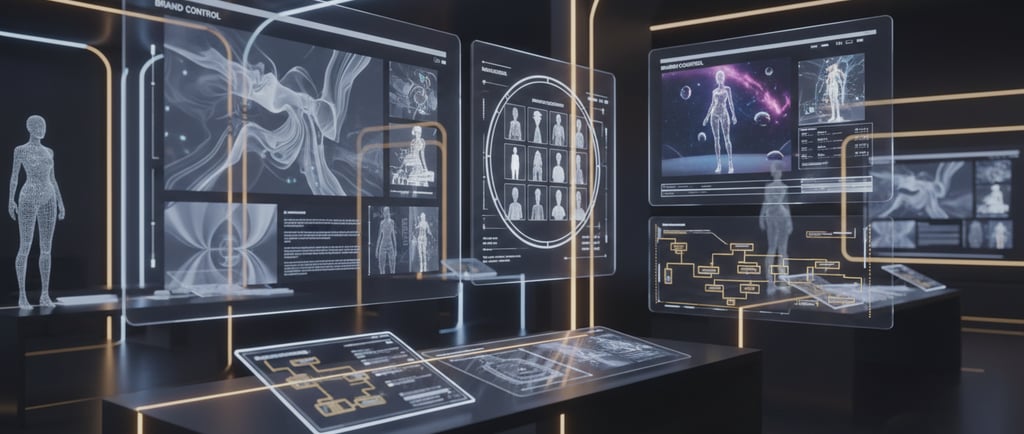
There's a quiet shift happening in your marketing operations: brands are replacing external agencies with internal synthetic talent. You're no longer relying on third parties when AI-driven teams can produce content faster, cheaper, and at scale. This move cuts costs and increases control, but risks homogenizing creative output. The agency model isn't dead-yet-but your playbook is changing.
The Ghost in the Marketing Machine
You’re no longer outsourcing creativity-you’re simulating it. In-house synthetic talent pools operate silently across your campaigns, generating content at scale without payroll or breaks. These digital workers, built from AI trained on years of brand voice and consumer data, now outperform traditional agencies in speed and consistency, making the human hand feel like a relic.
The erosion of the creative brief
Agencies once thrived on the creative brief-a shared document outlining goals, tone, and audience. Now, you feed raw data into models that infer intent without one. The brief dissolves into prompts and parameters, and strategic ambiguity becomes a liability when algorithms demand precision over inspiration.
Rise of the algorithmic avatar
An army of synthetic influencers, copywriters, and designers now lives inside your CRM and content engines. These algorithmic avatars mimic top performers, trained on your most successful campaigns. You don’t hire talent-you clone it, and scale it across channels without fatigue or cost.
Each avatar is more than a content generator-it’s a behavioral mirror reflecting your brand’s highest-performing traits. They adapt in real time, learning from engagement patterns and shifting tone mid-campaign. Unlike human creatives, they retain perfect memory of every A/B test, every sentiment shift, every conversion trigger. The danger? When every message feels optimal but emotionally hollow, you risk efficiency at the cost of authenticity.
Architecting the Synthetic Roster
You’re no longer limited by geography or availability when building talent. Synthetic avatars modeled on real human performers can represent your brand across markets, time zones, and campaigns-without scheduling conflicts or rising talent fees. This shift redefines how teams structure creative resources, placing AI-generated personas at the core of content pipelines.
Infinite personas on demand
One synthetic model can spawn dozens of distinct identities, each tailored to a region, demographic, or campaign goal. You control everything-from facial features to speech patterns-enabling rapid iteration without new casting. This scalability transforms how quickly you can launch and adapt messaging.
Distilling brand DNA into data
Your brand’s voice, tone, and visual identity are encoded into AI training sets, ensuring every synthetic output stays on message. Consistency becomes automatic, not aspirational, as algorithms replicate approved expressions across thousands of variations without drift.
Brand alignment now happens at the data level. Machine learning models ingest years of your creative work-ads, social posts, voiceovers, customer interactions-to extract patterns in language, emotion, and aesthetic. These signals form a behavioral blueprint, so synthetic talent doesn’t just look like your brand-they think and respond like it too, even in unscripted scenarios.
Ethical Shadows in the Digital Mirror
Every synthetic influencer you deploy reflects your brand’s values-sometimes in ways you didn’t intend. Deepfake technology blurs consent, especially when likenesses are replicated without permission. You’re not just building avatars; you’re shaping perceptions of identity, ownership, and truth in real time.
Authenticity in a deepfake world
Authenticity becomes harder to define when your audience can’t tell human from algorithm. Consumers now question every smile, every endorsement, unsure if they’re engaging with a person or a program. Your brand’s credibility hinges on transparency-without it, trust erodes faster than engagement grows.
The human cost of automation
Models and actors once relied on agencies for work, but your in-house synthetic talent cuts those roles out. Real people lose income while your digital avatars scale. You benefit from 24/7 availability, but behind the scenes, livelihoods are quietly displaced by lines of code you control.
Automation doesn’t just change workflows-it reshapes lives. When brands replace human creators with synthetic alternatives, freelance photographers, stylists, and makeup artists see fewer gigs. These aren’t abstract job losses; they’re real incomes vanishing from communities that depend on creative work. You may save on talent fees, but the industry’s foundation-people-bears the cost.
The Hybrid Survival Strategy
You’re already seeing the shift-agencies that survive aren’t resisting change, they’re adapting. Blending in-house synthetic talent with human creativity creates a powerful middle ground. You maintain control over speed and cost while preserving the nuance only people can bring. This hybrid model isn’t a compromise; it’s the new standard for competitive advantage.
Humans as prompt engineers
Your creative teams no longer just produce content-they shape intelligence. Writing precise, context-rich prompts has become a core skill, turning marketers into conductors of AI output. You’re not replaced; you’re elevated into roles that demand deeper strategic thinking and tighter brand alignment than ever before.
Rebranding the agency role
Agencies now position themselves as orchestrators of hybrid ecosystems, not just service providers. You’re expected to integrate synthetic tools seamlessly while guaranteeing brand safety and creative consistency. Their value isn’t in execution alone, but in curating quality across human and machine inputs.
Rebranding the agency role means shifting from being the sole creator to becoming the guardian of brand voice and strategic coherence. You rely on agencies not to do everything, but to design systems where AI scales efficiently without diluting authenticity. Their new mandate: ensure synthetic output feels intentional, on-brand, and emotionally resonant-not just fast.
Final Words
Upon reflecting on the shift toward in-house synthetic talent, you recognize this is not a temporary trend but a strategic repositioning of creative control. Brands are no longer outsourcing their voice-they’re building systems to generate it internally, reshaping how campaigns are conceived, produced, and scaled with speed and consistency.
Luxury
Elevate your brand with our exclusive AI models.
Contact us
THE SYNTHETIC FRONTIER
© 2026. All rights reserved.
(609) 901-8073