
The Death of Seasonal Collections
How AI Is Creating Fashion That Never Stops Evolving
6/22/20263 min read

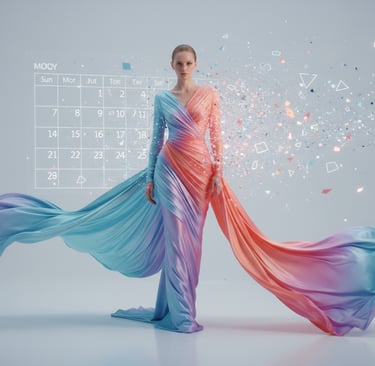
For over a century, the fashion industry has marched to the beat of a rigid, four-season drum. Designers would retreat for months to craft "Spring/Summer" or "Fall/Winter" collections, culminating in a high-stakes runway show that dictated what people would wear a half-year later. This "predict-and-push" model was built for a world of slower communication and physical manufacturing limits.
But in 2026, the calendar is collapsing. We are witnessing the Death of the Seasonal Collection.
AI is replacing the traditional episodic drop with a model of Continuous Evolution. By analyzing real-time cultural data and leveraging on-demand manufacturing, brands no longer need to guess what will be popular six months from now. Instead, they are launching "Live Collections" that update incrementally based on the current "vibe" of the internet. As consumers demand instant relevance, AI is turning the fashion cycle into a perpetual, high-velocity stream.
According to McKinsey, the efficiency of AI-driven design is finally making "on-demand" production more profitable than mass-batching. Vogue Business observes that the maturity of generative design tools is allowing brands to move beyond the static seasonal "drop" toward a state of frictionless, real-time creative output.
The Era of "Algorithmic Fluidity"
Traditional seasons were based on weather and the logistical lead times of global shipping. AI has solved the lead-time problem, and climate change has made traditional "winter" and "summer" weather increasingly unpredictable.
In a world of Algorithmic Fluidity:
Non-Stop Micro-Drops: Instead of 50 looks twice a year, a brand might release three new items every Friday—each one optimized for the specific social signals of that week.
Weather-Reactive Inventory: If a heatwave hits Northern Europe in October, the AI instantly pivots the design feed from knitwear to lightweight linens, updating the store’s "virtual windows" in seconds.
Trend Ingestion: When a specific aesthetic—like "maximalist utility"—starts trending on social platforms, AI design engines can generate a capsule collection and have it ready for pre-order before the sunset of the same day.
From "Dictating" to "Listening"
In the seasonal model, the designer was the dictator of taste. In the continuous model, the Algorithm is the Facilitator.
AI doesn't just design; it listens. It scans millions of TikTok videos, Discord threads, and Google Search queries to identify "Micro-Trends" that traditional designers might miss. By the time a human designer would have noticed a trend, the AI brand has already prototyped, tested, and sold it.
As Forbes notes, this shift from "pushing" a vision to "responding" to a community is the primary differentiator for Gen Alpha-focused labels in 2026.
The Sustainability Win: Zero Deadstock
Perhaps the most profound result of killing the season is the end of the End-of-Season Sale.
Traditional fashion brands lose billions every year because the "wrong" items were pushed into the market months in advance. These items eventually end up in landfills or being burned.
Reactive Manufacturing: In a continuous model, nothing is made until there is a signal of demand.
Zero Clearance: Because the AI iterates based on real-time feedback, the "sell-through rate" for these continuous collections is near 100%. The concept of "clearing out inventory" for the next season becomes obsolete when there is no "next" season—only a next week.
The Death of the "Runway" as We Knew It
If there are no seasons, what happens to Fashion Week?
In 2026, the runway has transformed from a "launch event" into a "Metadata Event." High-concept physical shows still happen, but they serve as "Data Feedstock" for the AI. The designs presented aren't final products; they are "Aesthetic Directions."
During the show, cameras capture audience reactions and social sentiment.
The AI then takes the core DNA of the runway presentation and iterates hundreds of wearable, retail-ready versions based on those reactions.
The collection that hits the shelves is a "community-refined" version of the original runway vision.
The Challenges: Creative Burnout and IP
While continuous production is efficient, it raises significant questions about Human Creativity. Can a human designer keep up with a machine that wants to release new items every day?
The solution is the move toward "Human-Centric Editing." Humans provide the core aesthetic philosophy—the "Soul" of the brand—while the AI manages the high-frequency iterations. Legal scholars like Shermin Lakha of Lvlup Legal are also grappling with how to protect "Fluid IP"—where a design might change slightly every day based on data inputs.
The Bottom Line: Fashion as a Service
We are moving away from fashion as an "Event" and toward fashion as an "Information Stream." The brands that win in 2026 will be the ones that can move as fast as the internet.
The death of the season is not the end of style; it is the beginning of a more responsive, efficient, and relevant industry. For the first time in history, fashion isn't telling the user what to wear in six months; it’s asking the user what they need tonight.
Luxury
Elevate your brand with our exclusive AI models.
Contact us
THE SYNTHETIC FRONTIER
© 2026. All rights reserved.
(609) 901-8073