The Creative Tug-of-War
"AI Slop" vs. Human Heritage
5/22/20263 min read
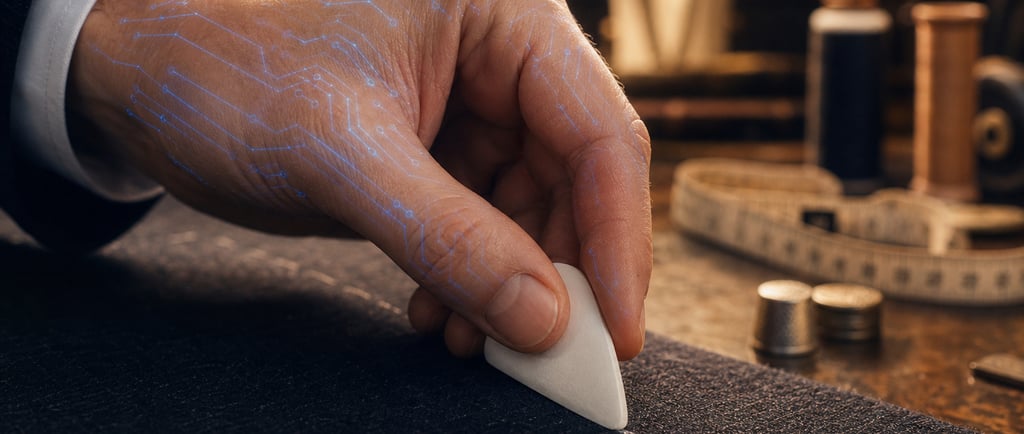
The fashion industry has reached a crossroads where the definition of "luxury" is being redefined. For decades, luxury was synonymous with human time—the thousands of hours spent on hand-embroidery, the master draper’s singular eye, and the physical presence of a supermodel in a specific location.
Today, generative AI can replicate the look of that luxury in seconds. It can create an "impossible" campaign in a surreal arctic desert featuring a "model" who doesn't exist. This has sparked a high-stakes creative tug-of-war: Should brands lean into the surreal, chaotic "AI Slop" aesthetic for shock value, or double down on human heritage to preserve authenticity?
As Vogue Business observes, there is now a "bifurcation" in the creative market. Brands are either rejecting the tech entirely to protect their human craft, or they are leaning into the surreal "glitch" look to catch the attention of a distracted digital audience.
The Rise and Fall of "AI Slop"
In 2025, the fashion industry was flooded with "AI Slop"—visuals that were realistic enough to be uncanny but clearly generated by a machine. At first, these campaigns were provocative. They allowed mid-sized brands to create high-budget aesthetics without the high-budget cost.
However, as the novelty wore off, "AI fatigue" set in. When every social media feed is filled with hyper-perfect, AI-generated imagery, "realness" becomes the new rare commodity. Leading trend forecasters now suggest that while AI’s "chaotic volatility" is great for short-term attention, it cannot build long-term brand identity. As noted in the Vogue Business 2026 outlook, "AI will provide the chaos, but human creativity will carry the meaning."
The Strategy of "Surreal Provocation"
Despite the fatigue, some brands are finding success by treating AI as a "surrealist paintbrush" rather than a replacement for photography. Instead of trying to pass AI off as real, they use it to create dreamscapes that physics wouldn't allow.
This includes:
Liquid Textiles: Garments that dissolve into water or pixels on a runway.
Impossible Architecture: Campaigns set inside a giant silk flower or a floating cathedral.
Entropic Aesthetics: Embracing the "glitches" of early AI—distorted limbs or melting textures—as a deliberate, avant-garde style choice.
The goal here isn't realism; it's escapism. In an era of global volatility, fashion marketing is leaning into the surreal to offer consumers a "beautiful glitch" in reality.
The Human Author as a Luxury Signal
Conversely, many high-end luxury houses are using AI to make their human craft even more prominent. When AI can do 80% of the work, the remaining 20% that only a human can do becomes the most valuable part of the product.
According to Forbes, AI acts as a "creative sparring partner" that allows designers to iterate through thousands of ideas to find the one that truly aligns with a brand’s physical heritage. By using AI to handle repetitive tasks—like generating mood boards or testing color palettes—designers can focus on "high-value-added activities" like the physical hand of the fabric or the specific tailoring that makes a garment feel unique on a human body.
This has birthed the trend of "Radical Transparency," where brands show the "behind-the-scenes" process of human makers working alongside digital tools. The message is: AI helped us imagine this, but a human hand gave it a soul.
The Intellectual Property (IP) Minefield
The tug-of-war isn't just about aesthetics; it’s about ownership. One of the biggest obstacles for "AI Slop" is the legal grey area. If a brand generates an entire campaign using AI, who owns the image? Can they protect their heritage if their "DNA" is being fed into public machine learning models?
Legal experts now warn that brands must become their own "regulators" through strict contracts. This means:
Protecting Archives: ensuring a brand’s historical photos aren't used to train third-party AI models without consent.
Closed Systems: building private, internal AI models that only "speak" the brand’s specific aesthetic language.
Human Sovereignty: ensuring that final creative decisions and "brand voice" remain firmly in human hands to maintain consumer trust. See: Shermin Lakha, founder of Lvlup Legal via Vogue.
The Future: A Division of Labor
The consensus among industry leaders in 2026 is that the future of branding isn't a replacement of humans, but a division of labor.
AI for Volatility: Short-term campaigns, surreal social media teaser, and Provocation.
Human Authorship: Long-term trust, physical craft, and brand credibility.
Consumers are increasingly savvy. They can spot "lazy" AI adoption and are quick to call it out as "slop." But when a brand uses AI to push the boundaries of what is possible—then grounds it in the physical craftsmanship of human heritage—they create a "hybrid luxury" that feels both futuristic and authentic.
The Bottom Line
The creative tug-of-war is ultimately about balance. Brands that over-correct into purely AI-generated worlds risk losing their humanity and intellectual property. Brands that ignore AI entirely risk falling behind the pace of the market.
The winners of 2026 are those who use AI to amplify their history, not overwrite it. The human hand is still the ultimate luxury signal; the AI is simply the most powerful tool that hand has ever held.
Luxury
Elevate your brand with our exclusive AI models.
Contact us
THE SYNTHETIC FRONTIER
© 2026. All rights reserved.
(609) 901-8073