
The AI Shopper Is Here
How Agentic Commerce Is Rewriting Fashion Discovery
5/18/20264 min read
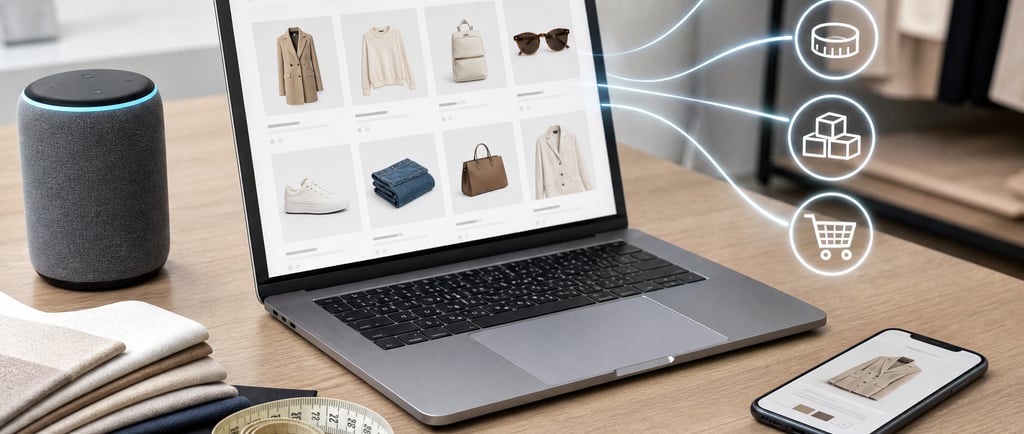
Fashion has always been a search problem—not just “find black boots" but “find something that feels like me, fits my body, matches the occasion, arrives on time, and won’t disappoint.” For years, that search happened through social feeds, Google keywords, retailer filters, and the occasional human stylist.
Now a new interface is taking over: shopping through conversation. The “AI shopper” is a customer who uses an AI assistant to discover products, compare options, and make decisions faster. Right behind that comes the bigger shift: agentic commerce, where AI doesn’t just recommend—it can take actions like tracking prices, checking inventory, and even completing purchases.
McKinsey describes this as a structural change in how people shop: consumers are turning to large language models (LLMs) for product discovery and tailored recommendations, and autonomous shopping agents may increasingly act on their behalf. That makes “AI chatbot responses” a new visibility battleground for brands. See: McKinsey — The State of Fashion 2026.
Meanwhile, fashion-tech coverage is already documenting how commerce platforms are adjusting, including the evolution of chat-based advertising and “sponsored prompts” within AI shopping experiences. See: Vogue Business — 2026 fashion-tech predictions.
What exactly is an “AI shopper”?
An AI shopper isn’t necessarily a robot. It’s still a person—someone who’s outsourcing part of their shopping brain to an assistant.
Instead of opening 15 tabs and manually cross-checking return policies, reviews, sizing, and shipping, they might ask:
“I have a winter wedding in Chicago. I’m 5'6" and curvy; I hate strapless. The budget is $250. I like minimalist but not boring things. Give me three options and explain why.”
That prompt includes context and constraints. Traditional e-commerce filters aren’t built for that kind of human language. LLMs are—and once shoppers feel how much friction this removes, behavior changes quickly.
From “AI advice” to agentic commerce (the real disruption)
There are two stages to understand:
AI as advisor (already happening): The assistant recommends items, summarizes reviews, compares brands, suggests styling, and narrows down choices. The customer still clicks “buy.”
AI as agent (emerging): The assistant can take actions: monitor price drops, find alternatives with faster shipping, reconcile sizing across brands, or place an order when conditions are met.
This is why “agentic commerce” matters. It converts shopping from a browsing activity into a task that can be delegated—especially in categories with high friction.
Fashion is high friction.
Fit uncertainty
Quality uncertainty
Decision fatigue
Overwhelming choice
Return anxiety
Agents exist to reduce friction. Fashion has plenty to reduce.
Why fashion is uniquely affected
Fashion sits at the intersection of emotion and logistics:
Emotional: identity, aspiration, taste, mood, self-presentation
Logistical: size, fabric behavior, shipping speed, price, inventory, returns
AI is naturally strong on the logistical side, but it’s getting surprisingly useful on the emotional side too—because personal style has patterns. If a shopper consistently likes clean silhouettes, neutral palettes, and certain fits, an assistant can learn that and recommend accordingly.
For brands, this creates two opposing realities:
Risk: AI can become the “front door” to shopping, reducing direct brand discovery.
Opportunity: If AI recommends you repeatedly, that becomes a new form of distribution and loyalty.
The funnel is changing: conversation → decision → purchase
Classic e-commerce assumes the shopper lands on your site early and moves through the following:
discovery
browse
product page
check out
In an AI-driven funnel, the shopper may never browse your category pages. They may see your product only after an assistant has already shortlisted options and summarized tradeoffs.
A likely flow looks like:
Conversation with AI (needs + constraints)
AI shortlists 3–7 products
AI explains tradeoffs (fit, fabric, value, shipping, return risk)
Customer chooses (or an agent chooses)
A purchase happens (sometimes without visiting your site)
That’s why McKinsey’s “AI chatbot responses as the new SEO” idea is so important. If the assistant’s summary is the first narrative a shopper sees, your brand’s product truth needs to survive that compression. McKinsey — The State of Fashion 2026
What brands must do next: AI Search Optimization (AISO)
This isn’t just “write better product descriptions.” It’s making your products machine-legible, preference-aware, and trust-ready.
Here are the practical levers:
1. Upgrade product data from attributes to meaning
Most product catalogs are built on surface attributes (color, material, sleeve length). AI shoppers ask for meaning:
“won’t wrinkle in a suitcase”
“breathable in humidity”
“looks expensive under $200."
“works for broad shoulders."
“not see-through”
Brands should enrich product info with:
fabric behavior (stretch, drape, opacity, thickness)
use cases (office, travel, wedding guest, day-to-night)
specific fit guidance (where it runs small/large)
styling logic (what it pairs with; silhouette notes)
If you can explain “why this works” clearly, AI can repeat it accurately.
2. Treat reviews as decision fuel (because AI will summarize them)
Customer reviews contain the language that helps shoppers decide:
“runs small in the bust."
“zipper feels flimsy."
“perfect for petites”
“color is warmer than photos."
AI assistants will compress these into a few lines. Your job is to improve the underlying signal:
collect more reviews
highlight consistent fit patterns
surface durability/quality feedback
fix recurring product issues that drive returns
3. Make policies easy to parse
Agents rely on rules. If your returns and shipping policies are confusing, buried, or inconsistent, AI may down-rank you simply because you’re risky.
Standardize and clearly present:
return window
exchange vs refund
final sale rules
shipping timelines and thresholds
warranty/repair policies (if applicable)
4. Build trust signals that survive summarization
When an AI recommends an item, it’s implying, "This is safe to buy.”
Trust signals include:
honest fit notes
multiple angles and close-ups
clear fabric composition
evidence of construction quality
consistent sizing across categories
Vague claims (“premium feel,” “luxury quality”) without proof won’t hold up when the user asks the assistant, “Why this one?”
Marketing changes too: from persuasion to eligibility
A key shift: AI assistants don’t “get persuaded” like humans do. They evaluate eligibility against constraints.
If a shopper says, “I need a blazer that travels well and doesn’t pill,” your marketing has to provide proof points that make you eligible: fabric blend, structure, abrasion resistance, weight, lining, and review evidence.
This is also why Vogue Business’ discussion of AI-era commerce ads matters: if shopping begins inside a conversation, visibility increasingly becomes conversational too, including paid placements inside AI shopping flows. Vogue Business — 2026 predictions
The bottom line
The AI shopper isn’t a novelty layer on top of fashion e-commerce. It’s an interface shift—like mobile, like social, like marketplaces. When shopping starts with a conversation, brands compete inside that conversation. When shopping becomes agentic, brands compete inside automated decisions.
If your product data is clear, your fit guidance is honest, and your trust signals are strong, you’ll be recommended—again and again.
If not, you may be invisible, even with a great product.
Luxury
Elevate your brand with our exclusive AI models.
Contact us
THE SYNTHETIC FRONTIER
© 2026. All rights reserved.
(609) 901-8073