
Generative Retail
Why the Shopping Malls of 2026 Are Becoming Interactive AI Playgrounds
7/1/20263 min read
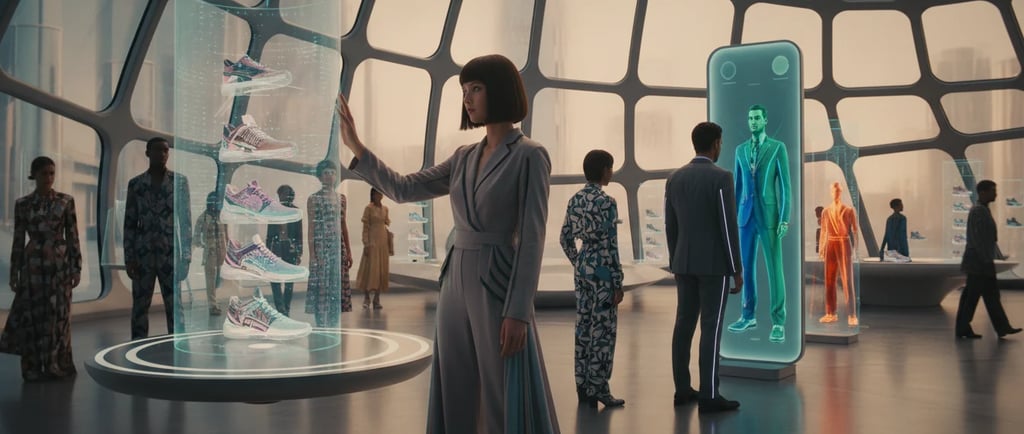
For the better part of a decade, the "Death of the Mall" was a standard industry headline. As e-commerce became more convenient, the physical retail store felt increasingly redundant—a dusty museum of inventory you could buy cheaper online. But in 2026, the mall is back, and it looks nothing like the department stores of the past.
We are entering the era of Generative Retail.
The physical store has transformed from a place where you "buy things" into a place where you "create and experience" them. Powered by the same "Fashion Operating Systems" (as discussed in previous posts), the retail environment is now a living, breathing AI Playground. These spaces don't carry thousands of items of stock; instead, they act as immersive portals where AI agents, spatial computing, and digital craftsmanship converge to offer an experience that a smartphone screen can never replicate.
As McKinsey highlights, the "Store of the Future" is now a media channel first and a sales channel second. Vogue Business notes that "Interactive Play" is the new metric of retail success, replacing "Sales per Square Foot."
The Store as a "Live Feed"
In 2026, a brand’s flagship store is no longer static. It is a physical manifestation of a "Live Collection."
Dynamic Merchandising: Using Computer Vision, the store’s layout actually changes its visual priority throughout the day. If the AI detects a high volume of "Streetwear Enthusiasts" entering the store at 4:30 PM, the holographic displays and smart-lighting instantly pivot to showcase the latest generative drops.
Holographic Endless Aisles: Stores carry "Hero Samples" for you to touch and feel, but the actual variety is infinite. Shoppers use "Spatial Swiping" to browse through thousands of digital variations of a garment, visualizing them in 3D scale right in the middle of the room.
The "Vibe" Score: AI sensors analyze the mood, music, and social energy of the crowd, adjusting the store’s ambient scent and lighting to maximize "Dwell Time."
The "Smart Mirror" is the New Sales Associate
The fitting room has undergone the most radical transformation. The "Smart Mirror" is no longer a gimmick; it is your AI Style Partner:
Instant Swap: When you try on a physical jacket, the mirror uses augmented reality to show you 20 different colors, patterns, and button options that aren't physically in the store.
The "Contextual Fit": The mirror can change your background—suddenly you aren't in a dressing room, you are standing in a digital simulation of a rainy street in London or a sunset gala in Ibiza, allowing you to see how the fabric reacts to different "virtual" lights and environments.
Agentic Checkout: Your AI Luxury Concierge (living on your device) "talks" to the store’s OS. You don't "check out" at a counter; you simply walk out with the item, and the transaction is handled silently through your verified digital identity.
Retail as "Content Creation"
Brands have realized that the best way to get people into a store is to help them create content.
Generative Backgrounds: Store walls in 2026 are often high-resolution LED or projection-mapped surfaces that allow shoppers to choose an AI-generated background for their "fit pics" or TikToks.
The "Creator Lab": Many stores now include small "Micro-Factories" or "Customization Ateliers" where you can sit with an AI design tool, co-create a custom bag or sneaker, and watch it being 3D printed or laser-etched in real-time.
As Forbes notes, this turns the consumer into a co-author of the brand, creating a level of loyalty that traditional advertising can't touch.
The Economics: Efficiency Through Experience
While these stores look expensive, they are actually a massive win for the bottom line:
Low Inventory, High Engagement: By carrying minimal physical stock ("Showrooming"), brands reduce the massive overhead of warehousing and unsold deadstock.
Zero-Waste Sampling: People "try on" 100 things digitally and buy 1 thing physically. This drastically reduces the carbon footprint associated with shipping and returning dozens of items.
Data Goldmine: Every interaction—what people swiped on, how long they looked at a specific texture, what they "tried on" in the mirror—is fed back into the brand's AI Brain to inform the next week's design cycle.
The Challenges: "Tech Fatigue" and Privacy
There is a fine line between "Interactive Playground" and "Overwhelming Surveillance."
The Human Touch: Brands are finding that the more "high-tech" the store becomes, the more important "high-touch" human service becomes. The job of the retail associate has shifted from "finding sizes" to "creative consulting."
Privacy Friction: Shermin Lakha of Lvlup Legal notes that the use of facial recognition and mood-tracking in retail is the next major regulatory battleground. Brands must be transparent about how "Retail Data" is used and stored.
The Bottom Line: The Renaissance of the Physical
In 2026, "going to the store" is no longer a chore; it is an outing. Generative Retail has saved the physical world by making it more exciting, more personalized, and more creative than the digital one.
The mall isn't dying—it’s just finally upgrading its operating system. If the 2010s were the era of "Online Shopping," the 2020s are the era of "In-Person Creating."
Luxury
Elevate your brand with our exclusive AI models.
Contact us
THE SYNTHETIC FRONTIER
© 2026. All rights reserved.
(609) 901-8073