
Deepfake Drapery
The Ethics and Economics of Placing Digital Clothes on Human Celebs
6/17/20263 min read
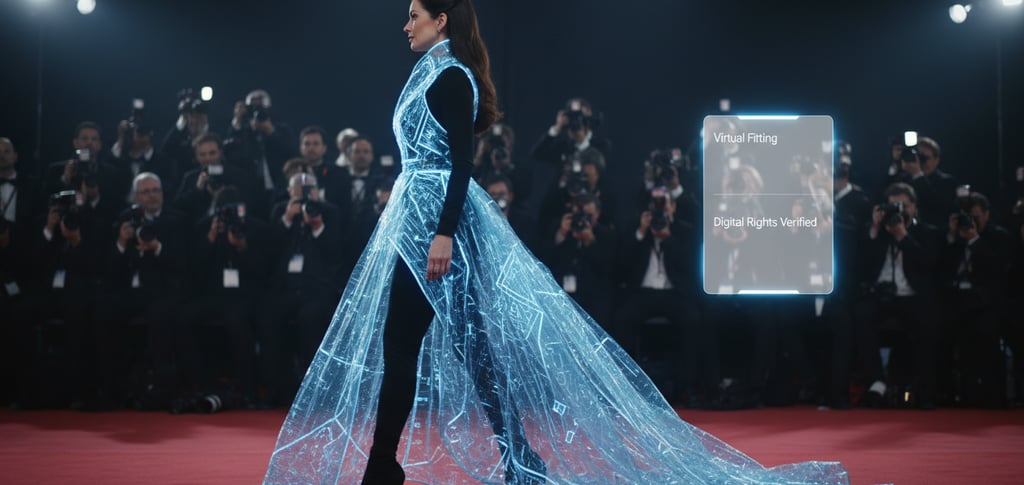
For a century, the "Celebrity Endorsement" was a physical logistical nightmare. It required flying a star to a location, a fleet of stylists, trunk-loads of high-value garments, and weeks of post-production. But in 2026, the red carpet is moving to the cloud. We are entering the era of Deepfake Drapery, where the garments worn by celebrities in magazines, social media, and even films are being placed there digitally after the fact.
By using high-fidelity generative AI and 3D simulation, brands are "draping" digital assets onto real human bodies with physics-perfect accuracy. This shift is revolutionizing the economics of luxury marketing, but it is also opening a Pandora’s Box of ethical questions regarding consent, authenticity, and the "Digital Rights" of the human form.
As Vogue Business observes, the maturation of digital clothing tech is creating a "post-physical" marketing landscape. McKinsey notes that for luxury brands, the ability to "test" garments on celebrities virtually is a major driver of operational efficiency in 2026.
The Tech: Beyond the "Photoshop" Era
"Deepfake Drapery" is fundamentally different from old-school retouching. It uses Neural Cloth Simulation to ensure the digital garment respects the celebrity’s actual anatomy and movement:
Physics-Perfect Movement: The AI calculates how silk, leather, or wool would actually react to the celebrity's skin, bone structure, and ambient lighting.
Lighting Integration: The digital clothes aren't just "pasted" on; they interact with the specific lighting of the original photograph—shadows, highlights, and reflections are computed in real-time.
Zero-Fit Marketing: A celebrity can be photographed in a simple "base" bodysuit, and a brand can then "dress" them in 100 different outfits for 100 different global markets without the celebrity ever changing clothes.
The Economics: The $10 Million Wardrobe for $100
From a business perspective, the ROI of digital clothing is undeniable:
Zero Shipping Risk: No more lost packages of one-of-a-kind couture.
Micro-Targeted Campaigns: A brand can dress a global ambassador in a red gown for a campaign in China and a blue gown for a campaign in France, using the exact same photoshoot.
The "Digital Sample" Pipeline: Brands no longer need to sew physical "press samples" for every major celebrity. They send a digital file to the celebrity’s stylist, who "fits" it to a photo using AI, and the image is ready for Instagram in minutes.
The Ethical Minefield: Consent and "Digital Likeness"
As we move into "Founderless" and "Synthetic" branding, the line between reality and generation is blurring. Deepfake Drapery raises critical questions:
The Consent Gap: Can a brand "dress" a celebrity in a garment they never actually wore or approved? In 2026, contracts are being rewritten to include "Digital Draping Clauses" that specify exactly which AI models can be used to modify a star’s image.
Body Image Expectations: If digital clothes can be perfectly "pinned" to any body type, does it worsen the industry's struggle with unrealistic beauty standards? Shermin Lakha of Lvlup Legal emphasizes that the legal protection of "likeness" now extends to how that likeness is dressed by AI.
The Authenticity Tax: Will consumers feel "cheated" if they find out their favorite star didn't actually wear the gown they are praising? The industry is responding with "Digital Content Labels" (similar to the ones used on TikTok) to disclose when an image has been digitally altered.
From Red Carpets to "Virtual Swaps"
The next frontier of Deepfake Drapery is Consumer Interaction. Imagine a celebrity posts a photo in a new collection. A "Virtual Swap" button allows you, the consumer, to instantly see how that exact same digital drape would look on your body (using your high-fidelity Digital Twin). This turns celebrity influence from a passive "look at them" moment into an active "try it on me" moment.
As Forbes points out, this is the ultimate bridge between the "aspiration" of luxury and the "utility" of e-commerce.
The Bottom Line: The Death of the Physical Sample
In 2026, the "garment" is a piece of data before it is a piece of fabric. Deepfake Drapery allows brands to tell more ambitious, more global, and more efficient stories than ever before. But as the physical logistical barriers fall away, the new barrier becomes Trust.
The brands that will win this era are those that use digital tools not to deceive, but to enhance—ensuring that even when the clothes are made of pixels, the relationship with the audience remains real.
Luxury
Elevate your brand with our exclusive AI models.
Contact us
THE SYNTHETIC FRONTIER
© 2026. All rights reserved.
(609) 901-8073