AI Styling Agents
The Death of the Influencer as We Know It
6/1/20264 min read
For the last decade, the fashion industry has been governed by the "Influencer." These taste-makers built empires on the premise of proximity: they were "just like us," but with better clothes and a pre-packaged aesthetic. We looked to them to show us how to wear a blazer, which sneakers were trending, and how to style a "capsule wardrobe." Brands poured billions into this middleman economy, betting that a human face and a curated feed were the ultimate tools for persuasion.
But that empire is facing a quiet, invisible challenger. We are entering the era of the AI Styling Agent.
Unlike an influencer, who offers a "one-to-many" broadcast of their own personal style, an AI Styling Agent offers "one-to-one" curation based entirely on the user’s body, closet, and context. As consumers move from following people to following algorithms, the multi-billion dollar influencer marketing industry is being forced to reckon with a future where the most trusted style advice doesn’t come from a human in Los Angeles, but from a neural network in the cloud.
As noted by McKinsey, 2026 marks the year where deep personalization becomes an operational requirement. Consumers are no longer satisfied with general inspiration; they want specific solutions to their personal "wardrobe problems." Vogue Business further supports this, predicting that AI’s maturation will lead to a new form of "cute tech" that feels more like a personal companion than a software tool.
The Scalability Problem of Human Influence
Influencers are inherently limited by their humanity. They can only wear one outfit at a time. They can only respond to so many DMs. Their style is fixed in their own physical reality. If you don't share their body type, skin tone, or regional climate, their "advice" is often more aspirational than practical.
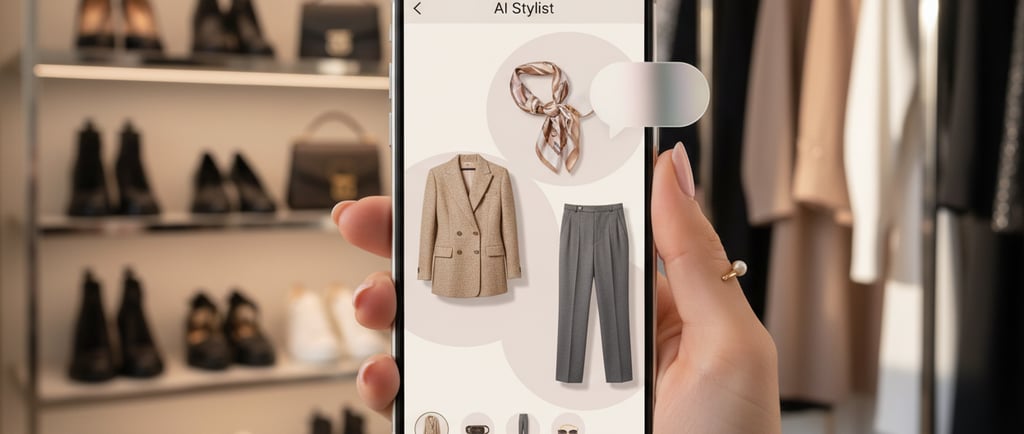
The AI Stylist, however, is infinitely scalable and hyper-local. An agent doesn't care about its own "aesthetic"; it cares about yours. It has access to:
Your Digital Closet: A database of everything you already own.
Your Biometrics: Your exact measurements and "fit double."
Your Context: Your calendar (a wedding in London?), your local weather (it’s raining?), and your budget.
When a shopper asks, "What should I wear with the green loafers I bought last month for a dinner tonight where I need to look professional but creative?" a human influencer can't answer that. An AI agent does it in three seconds, generating a fully rendered visual of the outfit using the user’s own digital twin.
From "Follow Me" to "Style Me"
The shift from influencer to AI agent represents a pivot from entertainment-led commerce to utility-led commerce.
For years, social media apps have tried to force "social commerce" (buying directly from feeds). While successful in some regions, many Western consumers have resisted, finding the experience cluttered and intrusive. AI Styling Agents offer a more "pull-based" alternative. Instead of being pushed a product by an influencer with a sponsored link, the user pulls a recommendation from their agent based on a specific need.
This change is fundamental:
Influencer Marketing: "Look at how good I look in this jacket. You should buy it."
AI Agentic Styling: "Here is how you will look in this jacket, paired with your favorite jeans, for your meeting on Wednesday."
The latter is a much more powerful conversion tool because it removes the "imagination gap"—the mental effort required for a shopper to see themselves in a garment.
The Death of the Affiliate Link?
This transition poses a massive threat to the traditional economy of the influencer. Most influencers rely on affiliate commissions (like LTK or Amazon Associates) and brand sponsorships.
In a world where an AI agent is the primary discovery tool, the brand’s relationship changes. McKinsey describes AI chatbot responses as a new form of SEO. If your brand isn’t the one being "shortlisted" by the styling agent, it doesn't matter how many influencers you pay. The agent becomes the "gatekeeper."
Brands are already shifting their budgets away from broad influencer "hauls" and toward:
API Integration: Ensuring their product data is "agent-ready" (clear fabric info, fit notes, and styling metadata).
Sponsored Prompts: Paying for a "preferred recommendation" status within styling apps (essentially the new "sponsored post").
Digital Fitting Tools: Providing the high-fidelity 3D assets that styling agents need to show a realistic fit.
The "Vibe" vs. The "Validation"
Some argue that AI will never replace influencers because AI lacks "soul" or "vibe." This misses the point of why people follow influencers in the first place. Most followers aren't looking for a soul; they are looking for validation. They want to know that an outfit is "cool" or "correct" for a certain social setting.
AI is becoming exceptionally good at codifying "vibe." By training on billions of social media images, street style photos, and runway archives, an AI agent can explain why an outfit works. It can say, "The proportions of this oversized blazer balanced with these slim trousers create a modern architectural silhouette that aligns with current minimalism trends."
This provides a different, arguably more objective, form of validation. It’s "data-backed taste."
Human Influence: The Luxury Pivot
Does this mean the influencer is dead? Not entirely—but it does mean their role is shifting.
As "utility-led" styling moves to AI, human influencers will likely pivot further into high-concept artistry and brand heritage. Much like we discussed in the "Authenticity Crisis," human hands and human faces will become "luxury signals."
The influencers who survive will be those who behave more like creative directors than personal shoppers. They will be the ones defining the "Aesthetic DNA" that the AI agents then learn and distribute. As Vogue Business suggests, the future is about "augmented creativity," where human taste-makers use AI to amplify their vision rather than being replaced by it.
The Bottom Line
The era of following a person just to see what they are wearing is ending. The friction of the "imagination gap" is too high for a 2026 consumer who expects instant, personalized solutions.
The AI Styling Agent is the new personal shopper—available 24/7, aware of every item in your closet, and capable of simulating your exact body in any outfit. For brands, the challenge is clear: you must stop optimizing for the "feed" and start optimizing for the "agent."
The influencer isn't just a person anymore; it’s an interface. And the interface is becoming smarter than the individual.
Luxury
Elevate your brand with our exclusive AI models.
Contact us
THE SYNTHETIC FRONTIER
© 2026. All rights reserved.
(609) 901-8073