
AI Casting Directors
How Algorithms Are Choosing the Next Faces of Fashion
6/26/20263 min read
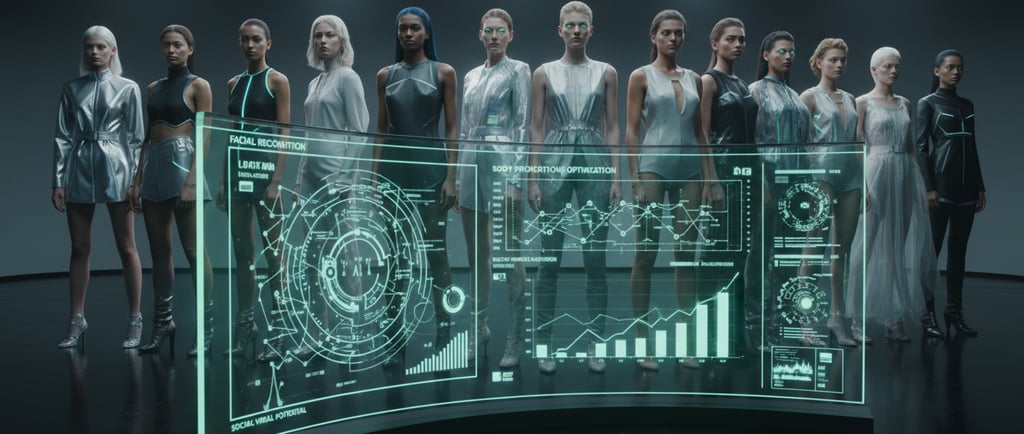
For decades, the path to becoming a fashion icon was controlled by a handful of legendary casting directors in Paris and New York. These "gatekeepers" relied on a mix of experience, intuition, and personal taste to decide who would walk the runway or front a global campaign. It was a world of polaroids, physical "go-sees," and the hope that a single scout would spot you in a crowded airport.
But in 2026, the gatekeeper is an algorithm. We are entering the era of the AI Casting Director.
From the initial discovery of talent on social platforms to the minute-by-minute analysis of a model’s "viral elasticity," AI is now the primary engine behind talent selection. By replacing subjective "gut feelings" with predictive analytics, brands are ensuring that the faces they choose aren't just beautiful—they are mathematically optimized to resonate with specific global subcultures.
As McKinsey notes, talent ROI is a critical metric for 2026, forcing agencies to adopt data-driven models. Vogue Business observes that as digital and physical realities merge, the role of the "casting director" has shifted from talent scout to "data curator."
Predictive Discovery: Scanning for the Next "It" Face
The "scout" of 2026 doesn't visit shopping malls; they run Multi-Channel Scraping Engines. AI models now scan millions of social media profiles, analyzing more than just aesthetics:
Engagement Velocity: The AI moves beyond follower counts. it identifies creators whose engagement is growing at an exponential rate within high-value niches (e.g., Japanese archival streetwear).
Sentiment Mapping: How do people talk about this person? AI analyzes comments to determine if the audience views them as "authentic," "aspirational," or "relatable"—traits that must align perfectly with a brand’s "Fashion OS" (as discussed in our previous post).
Physical "Fit" Prediction: Using AI vision, casting engines can estimate a model's measurements and gait fluidity from digital video, ensuring they fit the brand’s 3D digital patterns before they ever fly to a fitting.
The "Shadow Casting": Humans vs. Avatars
The most controversial shift in 2026 casting is the Mixed-Reality Runway. AI Casting Directors don't just choose between humans; they choose between humans and Synthetic Models.
The ROI of Perfection: A synthetic model never gets tired, requires no travel budget, and can be "re-skinned" instantly for different global markets.
The Hybrid Campaign: Major labels now frequently cast "Face Pairs"—a human model for physical events and an AI-generated twin for digital-only platforms, social gaming, and personalized "AI Concierge" interactions.
Hyper-Personalized Casting: For e-commerce, AI can dynamically change the model you see based on your own "Digital Twin" data. If you are 5'10" and based in Seoul, the AI "casts" a model on the product page that looks like a version of you, drastically increasing conversion rates.
Real-Time Runway Analytics
Even after a model is cast, the AI is still at work. During Fashion Week, brands use Computer Vision to analyze the "Impact" of every walk:
Viral Potential Score: The AI monitors live social feeds, heat-mapping which models are being screenshotted, shared, and discussed in real-time.
Gait Optimization: On the technical side, AI analyzes how the garment moves on the runway. If the AI detects that a model’s walk isn't showcasing the fabric’s drape correctly, it can provide haptic feedback or digital adjustments for the next show.
As Forbes notes, this level of scrutiny has turned "the walk" into a data-driven performance.
The Ethics of "Algorithmic Beauty"
The rise of AI casting has sparked a massive debate over Diversity and Bias. If an algorithm is trained on historical data of "successful" models, it risks perpetuating the same narrow beauty standards of the past.
The Diversity Audit: In 2026, ethical fashion labels are using "Adversarial AI" to deliberately challenge their casting algorithms, ensuring a broader representation of age, size, and ethnicity.
Digital Rights: Shermin Lakha of Lvlup Legal points out that "Likeness Rights" are the new battleground. If an AI "scans" a model and then creates a synthetic version that looks 90% like them, who owns that commercial value?
The Talent Agency of the Future
Traditional modeling agencies are transforming into Data Agencies. They no longer just manage schedules; they manage the "Digital Assets" of their talent. Agencies now help models build their own "AI Personas," allowing them to "work" on 100 digital campaigns simultaneously while their human self is on a beach in Ibiza.
The Bottom Line: Beauty as a Data Point
The AI Casting Director has turned the search for beauty into a search for Resonance. It is no longer enough to be "pretty" or "cool." In 2026, you must be "relevant" to the specific cluster of data the brand is targeting.
While the "magic" of a supermodel like Kate Moss or Naomi Campbell can never be fully quantified, the industry has decided that it can no longer afford to guess. The machine is making its choice, and for the first time, the "Face of the Future" is a product of code as much as nature.
Luxury
Elevate your brand with our exclusive AI models.
Contact us
THE SYNTHETIC FRONTIER
© 2026. All rights reserved.
(609) 901-8073